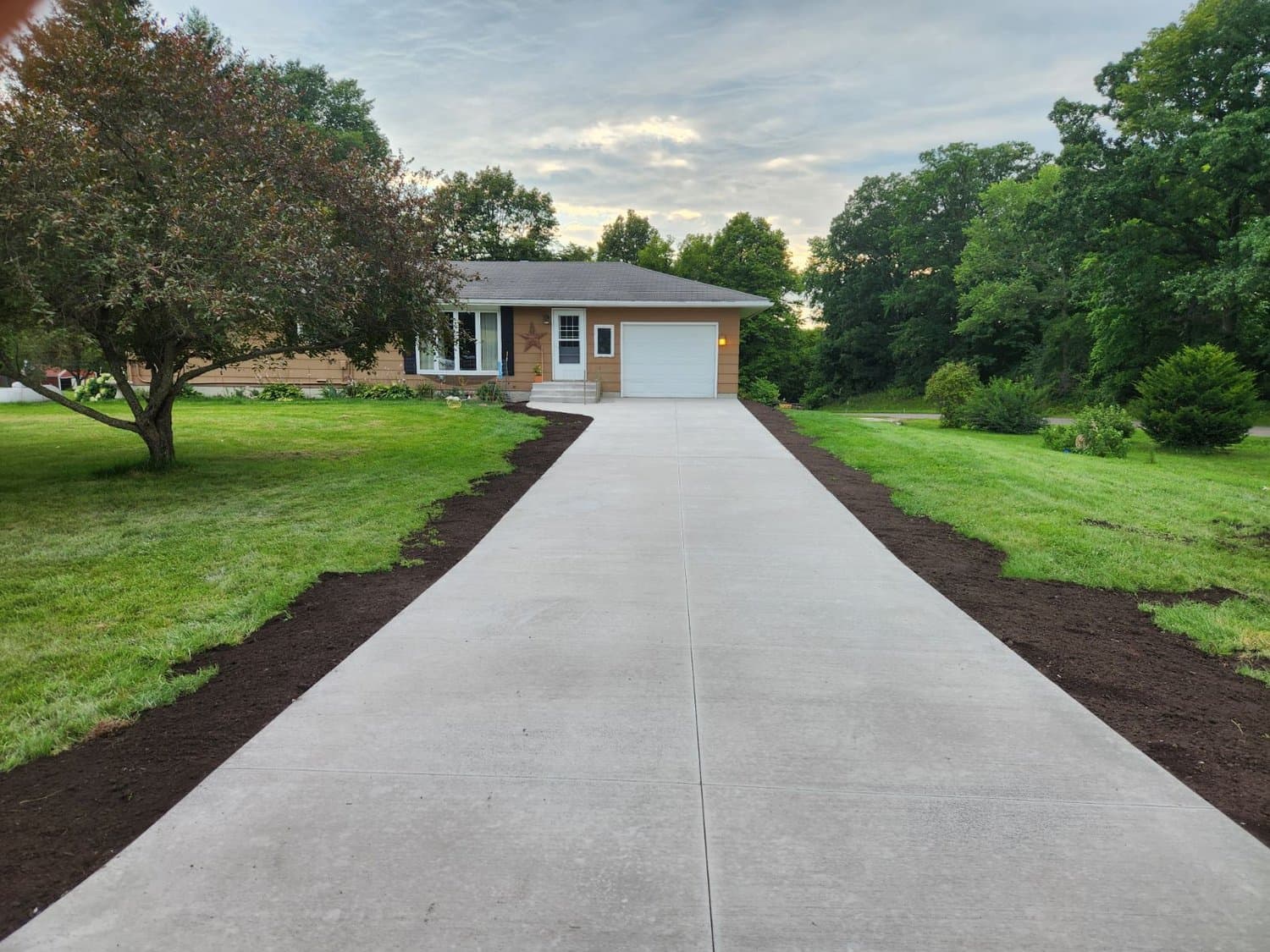
Concrete driveways in London, Ontario: what goes into a durable pour
A concrete driveway that lasts in London is decided mostly by what happens before the concrete arrives. Here is what proper base prep, thickness, reinforcement, and drainage look like on a London driveway, and what affects cost and timeline.
Base preparation for London's clay soil
London sits on predominantly clay soil, which expands when saturated and contracts when it dries, and heaves when it freezes. That movement is the single biggest cause of cracked and uneven driveways in this region. Before any concrete is formed, we excavate to remove topsoil and unstable material, then place and compact a granular base - typically 6 inches (150mm) of crushed stone for a standard driveway - to create a stable, well-drained layer between the clay and the concrete. Skipping or under-compacting this step is the most common reason older driveways in London settle unevenly within a few years.
Thickness and reinforcement
A standard residential driveway is poured at 4 inches (100mm) thick. If the driveway will also see truck or trailer traffic, or if it doubles as a parking pad for heavier vehicles, we recommend increasing to 5-6 inches (125-150mm) with rebar reinforcement rather than wire mesh alone. Wire mesh helps control minor surface cracking on a standard driveway, but rebar spaced on a proper grid gives meaningfully more structural strength where heavier loads are expected.
Control joints and why they matter
Concrete cracks as it cures and as temperatures swing through an Ontario year - that is unavoidable physics, not a defect. Control joints are cut or tooled into the surface at planned intervals so that cracking happens along a straight, hidden line instead of randomly across the visible surface. Joint spacing is typically set at roughly 2 to 2.5 times the slab thickness in feet, and we plan joint layout before forming so it lines up with the driveway's actual dimensions rather than being an afterthought.
Drainage and grading
Every driveway we form is sloped - usually a 1-2% grade - to move water away from your garage, foundation, and any neighbouring property line, consistent with City of London grading expectations. Poor drainage is what causes standing water to freeze on a driveway surface in winter, which is both a safety hazard and a source of surface scaling from repeated freeze-thaw cycling. If your lot has unusual drainage challenges, such as proximity to a low area near the Thames River watershed, we address that in the grading plan before the pour.
Finish options
A broom finish is the standard choice for driveways because it provides reliable traction in wet or icy conditions - important with London's winter salt and snow. Homeowners who want a more distinctive look often choose stamped concrete driveway options in one of 50+ patterns, or a coloured finish. See concrete finishes for a full comparison of broom, exposed aggregate, smooth trowel, stamped, and coloured concrete.
Timeline and cost factors
Most residential driveways take 2-3 days: excavation and forming on day one, pouring and finishing on day two, with a third day if weather or site conditions require it. Vehicles should stay off the surface for the full 7-day cure period, even though the concrete reaches walking strength in 24-48 hours. Standard driveway pricing in London runs $10-$16 per square foot, including excavation, grading, reinforcement, the pour, and a broom finish; stamped work runs $15-$25 per square foot. Site access, existing slab removal (see concrete removal services), and unusual grading all factor into the final quote.
Permits and City of London expectations
A straightforward driveway replacement in the same footprint typically does not require a permit, but widening a driveway or changing the curb cut may need approval from the City of London, particularly around setback and drainage requirements. We review this during your free estimate and handle the paperwork discussion with you before excavation starts, so there are no surprises partway through the project.
More questions
Can you widen my existing concrete driveway instead of replacing the whole thing?
Yes, driveway widening is one of our common projects. We tie the new pour into the existing slab with doweled reinforcement where possible, and match the finish so the addition blends in rather than looking patched on.
Will my new driveway crack eventually?
Some hairline cracking within control joints is normal for any concrete driveway over its lifespan, especially through Ontario's freeze-thaw cycles. Proper joint placement, base compaction, and reinforcement are what keep cracking controlled and cosmetic rather than structural.
How does road salt affect a new concrete driveway?
Repeated exposure to road salt can accelerate surface scaling on concrete over many winters. We recommend sand for traction where possible and, for stamped or coloured driveways, a sealer that is reapplied every 2-3 years to protect the surface.
Do you match new concrete colour to an existing patio or walkway?
We can get close using integral colour or a colour hardener, but concrete colour naturally varies with age and sun exposure, so an exact match to older concrete is not guaranteed. We will show samples during your estimate so you know what to expect.