How concrete removal actually works, from breakout to a new pour
Removing old concrete is more than swinging a breaker at a slab. Here is what happens to the base underneath, how disposal works, and how removal connects directly into a new pour if you are replacing what comes out.
Breaking out the old slab
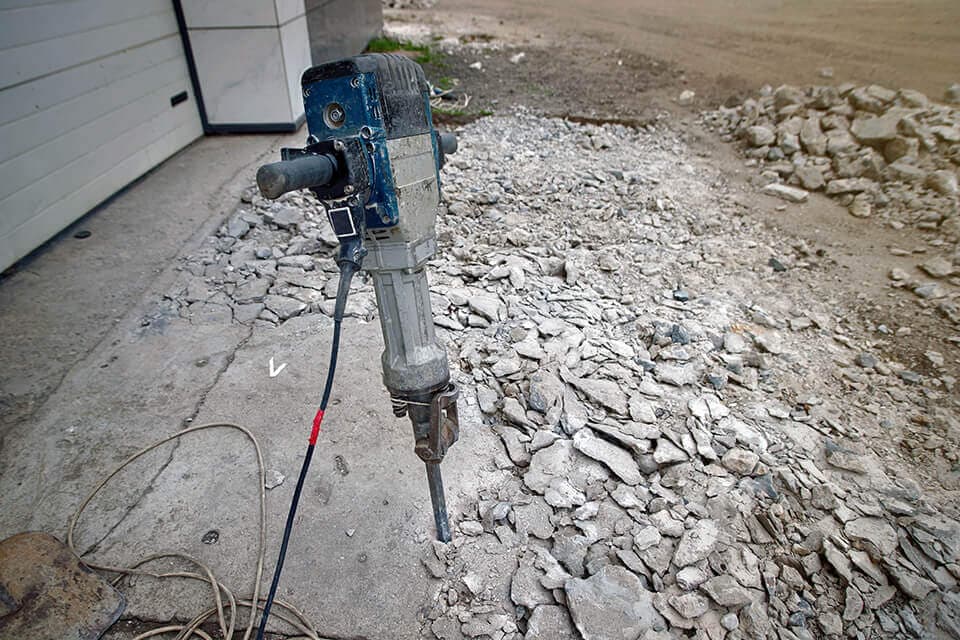
We use hydraulic breakers for most driveway, patio, and walkway removal, switching to hand tools and smaller equipment when working close to a foundation, fence, or landscaping we need to protect. Reinforced slabs - those poured with rebar rather than wire mesh - take longer to break out because the rebar has to be cut free from each section before it can be loaded, which is one reason older, heavier driveways sometimes cost more to remove than a thinner unreinforced patio.
What happens to the base underneath
Once the concrete is out, we inspect the granular base and subgrade underneath. If the existing base is in reasonable condition, compacted, and free of organic material or clay contamination, it can sometimes be reused or topped up rather than fully re-excavated, which reduces cost on a replacement project. More often in London, especially on older properties, the original base has settled unevenly or has clay intrusion from years of ground movement, and we recommend re-excavating to proper depth and placing fresh compacted granular material before any new pour - see concrete driveways for how we build that base for a new driveway.
Disposal and site cleanup
Full removal and disposal is included in every removal quote - we bring a bin or truck, break out the concrete, load it, and leave the site clean and graded. Most residential removal jobs (driveways, patios, walkways) are completed in a single day, with larger or heavily reinforced projects sometimes taking two days.
Combining removal with a new pour
Most homeowners calling about concrete removal are replacing what comes out, not just clearing space. When removal and a new pour are quoted together, we plan the excavation depth for the new project from the start rather than removing to a shallower depth and then having to dig again, which saves a mobilization trip and usually reduces total cost. This applies whether the new project is a standard concrete driveways replacement, a stamped concrete driveway upgrade, or a new concrete patios in the same footprint.
Working near foundations and structures
Concrete poured against a foundation, garage wall, or steps needs careful handling during removal so the adjacent structure is not damaged. Our crews use smaller hydraulic breakers and hand tools in these tight areas, and we assess the connection point between old concrete and any structure during the estimate so we know exactly where breakout needs to slow down.
Permits for removal
In most cases, no permit is required simply to remove a driveway, patio, or walkway in London. If the replacement project changes the footprint, widens a driveway, or affects a setback that was compliant only under older rules, a permit may be required for the new installation even though the removal itself did not need one - we flag this during the estimate so it does not surprise you partway through the project.
Cost
Concrete removal typically costs $3-$6 per square foot depending on thickness, reinforcement, and site access. A typical driveway (400 sq.ft.) runs $1,200-$2,400 for demolition, removal, and disposal. Combining removal with a new pour is quoted as a single project and often costs less overall than booking the two separately.
More questions
Can you remove just a section of a driveway instead of the whole slab?
Yes, we can cut and remove a defined section using a concrete saw to create a clean edge, which is common for repairing a damaged corner or preparing for a widening project without disturbing the rest of the driveway.
What happens to rebar or wire mesh pulled out during removal?
Metal reinforcement is separated from the concrete during breakout and disposed of or recycled separately - it does not go into the same load as the concrete debris.
Will removal damage my lawn or landscaping around the slab?
We take reasonable precautions with equipment placement and loading routes, but some disturbance to grass or plantings immediately adjacent to the work area is common with heavy equipment on site - we discuss this during the estimate so you know what to expect.
How much notice do you need to schedule a removal project?
Once you approve a quote, we typically schedule removal within a couple of weeks depending on our current workload and weather, and we will give you a firm date before the crew arrives.